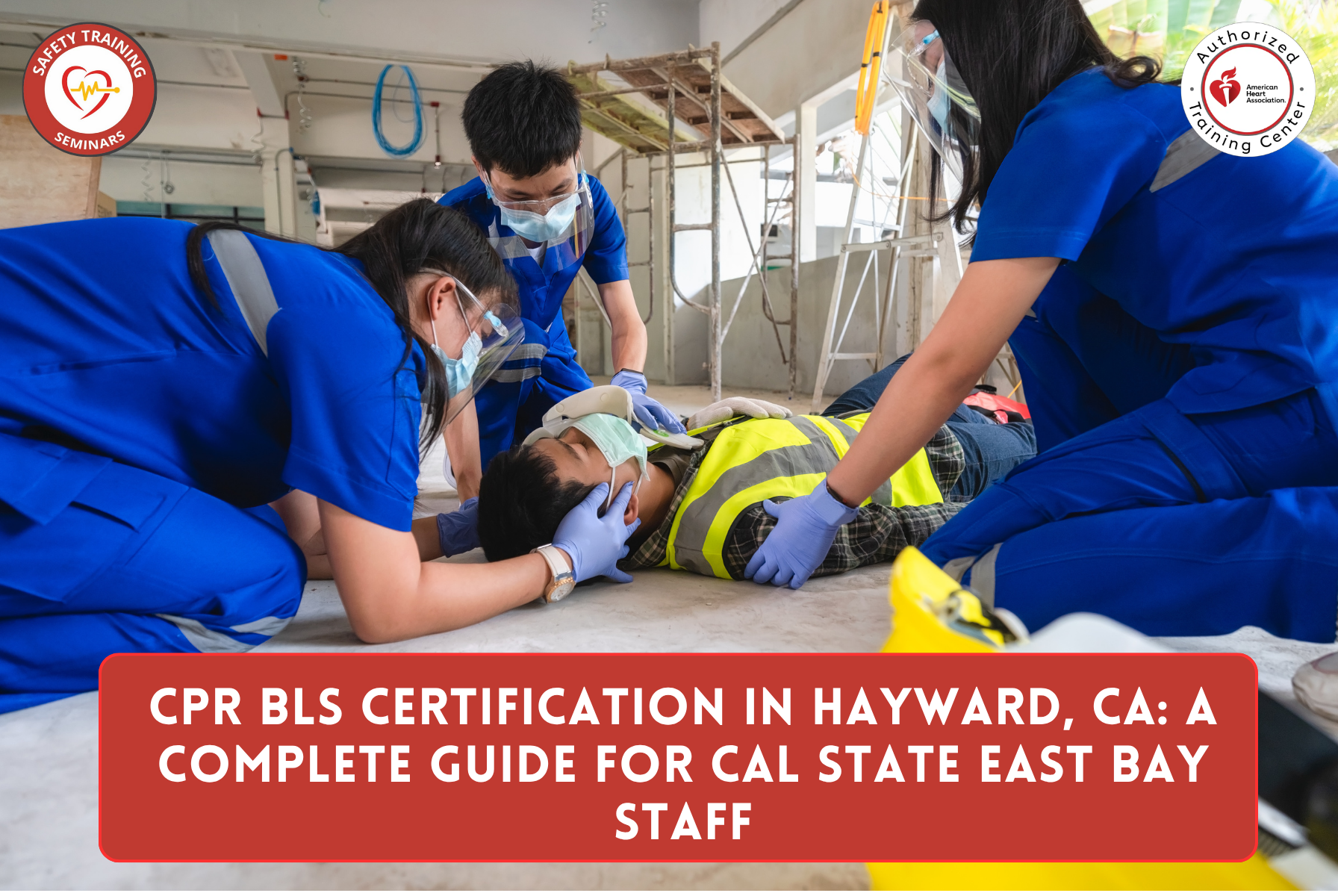
Hayward is home to Cal State East Bay employees, hospital staff, childcare workers, and families from dozens of different backgrounds, and a surprising number of them need a BLS CPR certification course at some point for work, school, or peace of mind. If you searched for this guide because your employer just told you your card expired, or because you are starting a nursing prerequisite, you are in the right place. A BLS CPR Certification Course teaches adult, child, and infant CPR, AED use, and choking response, and most people can complete one in a single day at a local training center like the one at 1070 A Street, Suite 4, Hayward, CA 94541.
This guide walks through who typically needs BLS versus a shorter First Aid or CPR course, what actually happens during a class, how to tell a legitimate provider from a questionable one, and where Hayward residents and Cal State East Bay staff can go for training without driving into Oakland or San Francisco.
Key Takeaway
A BLS CPR Certification Course is built for healthcare workers, students in clinical programs, and Cal State East Bay staff who need a card that satisfies employer or school requirements. It differs from general public CPR and First Aid courses because it follows a healthcare provider standard that includes two-person CPR, team dynamics, and AED integration. Most Hayward students complete the hands-on portion in a few hours at a local training center.
Who Actually Needs BLS Versus a General CPR Class
Not everyone searching for CPR certification needs the same course, and this is where a lot of first-time students get confused.
BLS, which stands for Basic Life Support, is generally required for:
- Nurses, nursing students, and nursing assistants
- Medical assistants, EMTs, and paramedics
- Dental staff and dental hygiene students
- Hospital, clinic, and lab employees
- Some Cal State East Bay staff working in health sciences, athletics, or student health services
If you work in an office, run a daycare, coach youth sports, or simply want to be prepared at home, a standard CPR and AED course or a First Aid course is usually the better fit. Employers and clinical programs are specific about which certification they require, so the safest step before enrolling is checking your job description, syllabus, or HR onboarding paperwork for the exact course name.
What Happens During a BLS Class
A typical BLS class combines a short lecture or online cognitive portion with a hands-on skills session. During the in-person portion, students practice:
- High-quality chest compressions on a training manikin
- Rescue breathing techniques for adults, children, and infants
- Using an AED, including pad placement and rhythm analysis
- Responding to choking in conscious and unconscious victims
- Two-rescuer CPR and basic team communication, which is unique to the BLS provider level
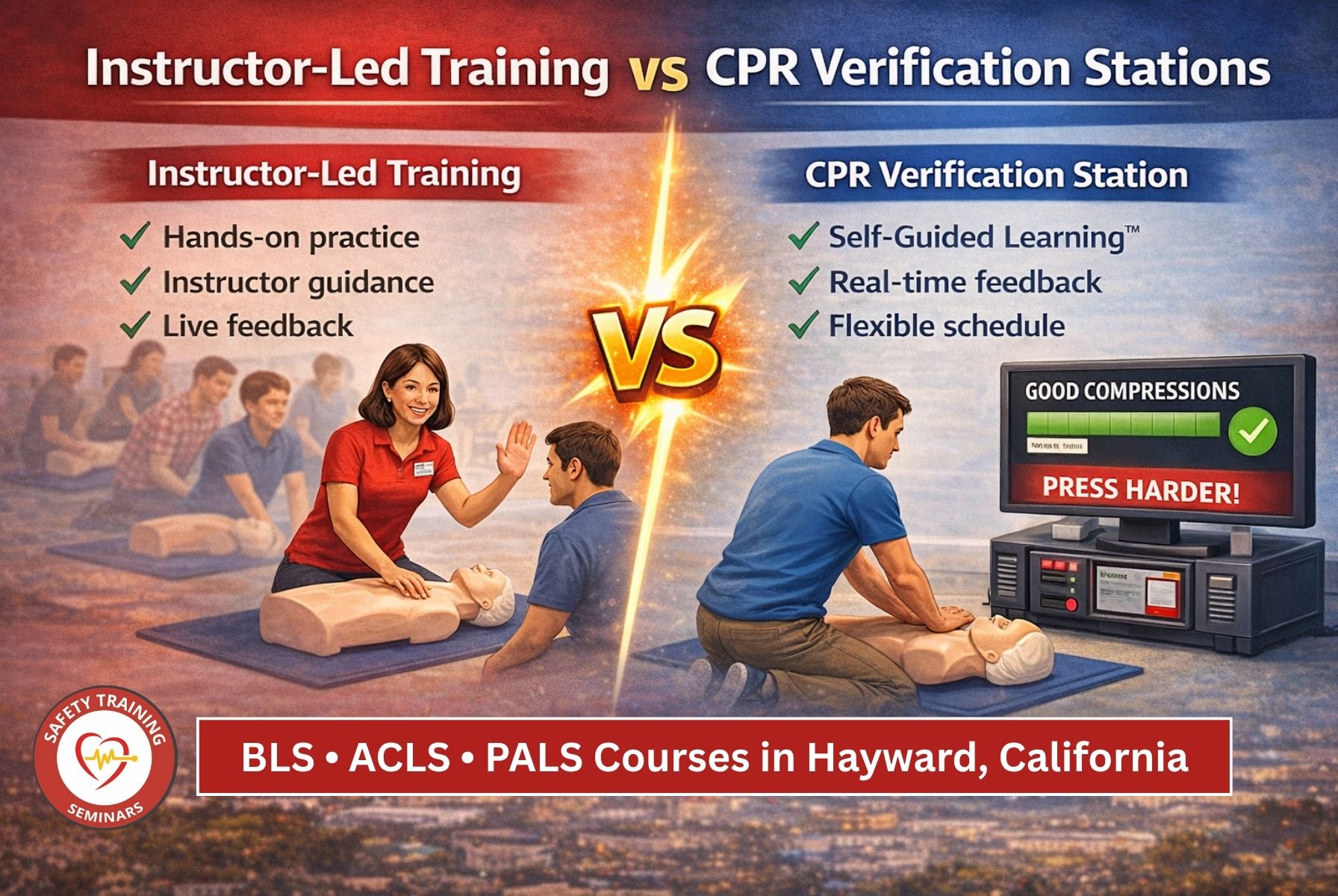
Instructors correct hand placement, compression depth, and rate in real time, which is the main reason employers and clinical programs generally will not accept a certificate from an online-only course with no skills check. If your school or workplace requires a skills verification, ask the provider directly whether their course includes one, since this varies by organization.
How Long Does BLS Certification Stay Valid
Certification renewal periods are set by the certifying organization, not by individual training centers, so the exact timeframe can vary depending on which certification body issued your card. Most healthcare employers and clinical programs expect BLS students to renew before their card expires rather than after, since a lapsed certification can affect scheduling for clinicals, shifts, or licensing paperwork. If you are unsure when your current card expires or what your program requires, your school’s clinical coordinator or your HR department will have the accurate answer for your specific situation.
Choosing a Legitimate Local Provider
Hayward has several options for CPR and BLS training, and it helps to know what separates a straightforward, well-run class from one that might cause problems later with an employer or licensing board.
Ask a potential provider:
- What organization certifies the course, and does the eCard or certificate reflect that clearly
- Whether the skills session is instructor-led and in person, not just a video with a signature
- How class size is managed so everyone gets real manikin time
- What happens if you need to reschedule
A local training center that can answer these questions directly, without vague marketing language, is usually a safer choice than an unfamiliar national website you found through an ad.
Cal State East Bay Staff and Students: What to Know
Cal State East Bay’s Hayward campus includes health sciences programs, athletics staff, and student health services, all of which commonly require CPR or BLS documentation. Staff and students in these departments should confirm with their department or program office which specific certification level is required, since requirements can differ between nursing, kinesiology, and general staff roles. Because the campus sits close to downtown Hayward, staff often look for a nearby training center rather than losing a half day of work driving to the Peninsula or into the city.
Serving Hayward’s Working Families and Local Professionals
Hayward’s working population includes healthcare staff, teachers, caregivers, tradespeople, and small business owners, many of whom need certification for reasons that have nothing to do with a hospital job. Childcare providers licensed through the state often need CPR and First Aid on file. Parents and grandparents sometimes take a class simply because they want to feel prepared. Contractors and warehouse teams occasionally need workplace-mandated CPR as part of a safety program.
Because needs vary this much across one city, it is worth confirming which specific course applies to your situation before you register, rather than assuming BLS is always the right choice.
Safety Training Seminars in Hayward
Safety Training Seminars operates a training center at 1070 A Street, Suite 4, Hayward, CA 94541, offering CPR, BLS, ACLS, PALS, NRP, and First Aid courses for the local community. The location is accessible for Cal State East Bay staff, downtown Hayward employees, and residents from surrounding neighborhoods who want to complete certification without significant travel. Students working in healthcare, education, or childcare, along with community members who simply want practical emergency-response skills, can review course details and scheduling directly with the training center before enrolling.
For readers in nearby communities, CPR, BLS, ACLS, and PALS course details for Fremont-area students and local certification options for Berkeley healthcare workers outline what to expect at nearby training locations. Students commuting from the Tri-Valley area may also find it useful to check BLS and ACLS class information for Dublin residents, while those closer to the Emeryville business corridor can review CPR and First Aid course scheduling for Emeryville professionals.
Frequently Asked Questions
Do Cal State East Bay staff need BLS or a general CPR course? It depends on the department. Health sciences, athletics, and student health staff typically need BLS, while general administrative staff may only need standard CPR and AED training. Checking with your supervisor or HR is the most reliable way to confirm.
Is an online-only BLS certificate accepted by Hayward employers? Most healthcare employers and clinical programs in the Hayward area expect an in-person or blended course that includes a hands-on skills check, since online-only certificates without instructor evaluation are often not accepted for clinical or hospital settings. Confirm this requirement directly with your employer or program.
Can Fremont or Castro Valley residents attend BLS classes in Hayward? Yes. Hayward is centrally located in the East Bay, and residents from Fremont, Castro Valley, and nearby communities regularly travel to Hayward for certification classes rather than driving further into Oakland or San Francisco.
What should I bring to a BLS class in Hayward? Most training centers ask students to bring a photo ID and to wear comfortable clothing suited for kneeling and hands-on practice. If your course includes an online cognitive portion beforehand, bring proof of completion if requested.
How is BLS different from a general public CPR and AED course? BLS is designed for healthcare providers and includes two-rescuer CPR, team-based response, and integration with AED and airway equipment, while general public courses focus on single-rescuer response for everyday emergencies.
Final Thoughts
Choosing between BLS, CPR, and First Aid comes down to what your employer, school, or licensing body specifically requires, and that answer is usually available in your onboarding paperwork or program syllabus. Hayward residents, including Cal State East Bay staff and students, have a local option at Safety Training Seminars’ training center on A Street rather than needing to travel across the East Bay for certification. If you are ready to compare course options in the surrounding area, the location pages for nearby cities linked above outline scheduling and course details to help you register for the certification that matches your role.